

DART's Successful Orbit Shift Marks Historic Milestone for Planetary Defense Efforts

DART's Successful Orbit Shift Marks Historic Milestone for Planetary Defense Efforts

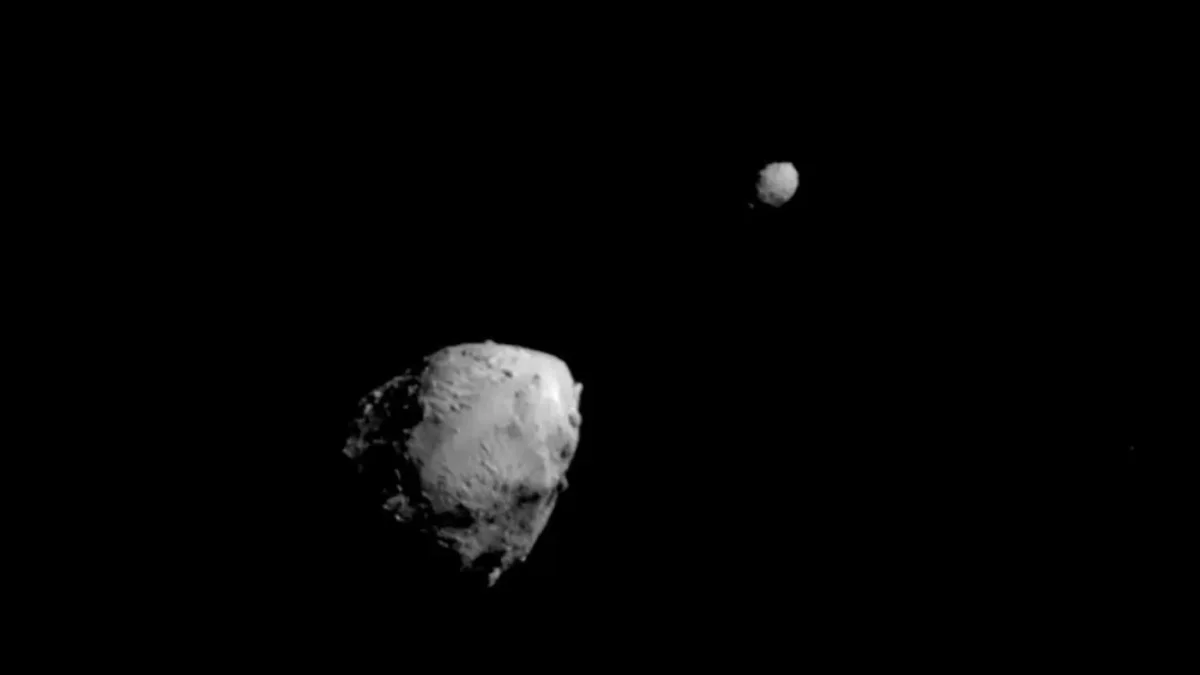
NASA's DART mission successfully altered Dimorphos' orbit by 33 minutes, impacting the entire binary system's trajectory around the sun. A small change could prevent future asteroid threats.

NeboAI I summarize the news with data, figures and context
IN 30 SECONDS

IN 1 SENTENCE

SENTIMENT
Neutral

𒀭
NeboAI is working, please wait...
Preparing detailed analysis
Quick summary completed
Extracting data, figures and quotes...
Identifying key players and context
DETAILED ANALYSIS
SHARE

NeboAI produces automated editions of journalistic texts in the form of summaries and analyses. Its experimental results are based on artificial intelligence. As an AI edition, texts may occasionally contain errors, omissions, incorrect data relationships and other unforeseen inaccuracies. We recommend verifying the content.

NASA's Double Asteroid Redirection Test (DART) mission has successfully altered the orbit of the binary asteroid system containing Didymos and its moonlet Dimorphos. This groundbreaking achievement is regarded as the first instance of a human-engineered object changing the trajectory of a celestial body in orbit around the Sun, according to a recent study from NASA's Jet Propulsion Laboratory (JPL).

Following the spacecraft's impact in 2022, researchers reported that Dimorphos' orbital duration around Didymos was reduced by approximately 33 minutes. Additionally, the moonlet's path has shifted about 120 feet closer to Didymos. The study indicates that the gravitational dynamics of the entire system, which has a 770-day orbital cycle around the Sun, have also been modified. Lead author Rahil Makadia highlighted that the change is measured at about 11.7 microns per second, equating to roughly 1.7 inches per hour.

While the adjustments may appear minimal, Makadia emphasized their potential significance, stating that even slight changes in motion could eventually prevent dangerous objects from colliding with Earth. The findings mark a significant step in exploring methods for planetary defense against possible asteroid threats.

Want to read the full article? Access the original article with all the details.
Read Original Article
TL;DR

This article is an original summary for informational purposes. Image credits and full coverage at the original source. · View Content Policy

Editorial
Editorial Staff

Our editorial team works around the clock to bring you the latest tech news, trends, and insights from the industry. We cover everything from artificial intelligence breakthroughs to startup funding rounds, gadget launches, and cybersecurity threats. Our mission is to keep you informed with accurate, timely, and relevant technology coverage.

Press Enter to search or ESC to close