
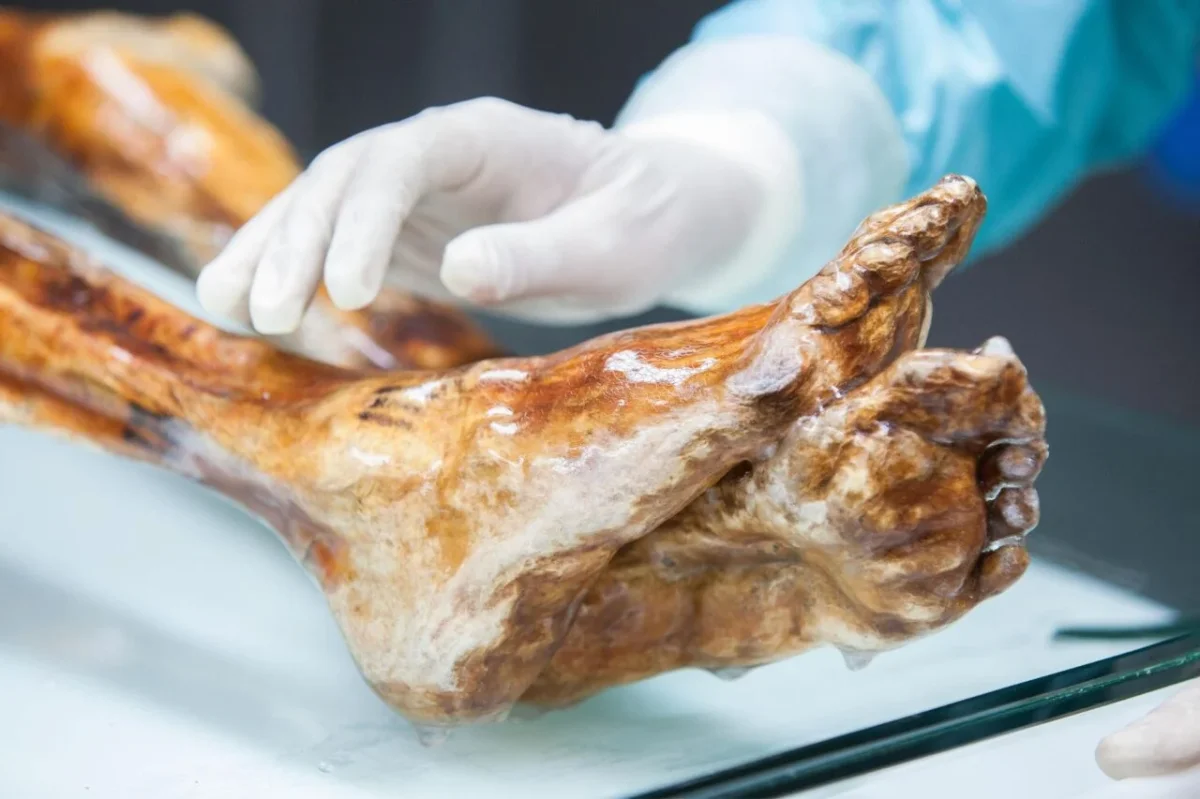

5,300-Year-Old Ötzi the Iceman’s Microbes Reveal Secrets of Ancient Survival

5,300-Year-Old Ötzi the Iceman’s Microbes Reveal Secrets of Ancient Survival

Ötzi the Iceman, discovered in 1991, reveals 5,000-year-old living microbes, challenging preservation methods and highlighting the complexity of ancient ecosystems.

NeboAI I summarize the news with data, figures and context
IN 30 SECONDS

IN 1 SENTENCE

SENTIMENT
Neutral

𒀭
NeboAI is working, please wait...
Preparing detailed analysis
Quick summary completed
Extracting data, figures and quotes...
Identifying key players and context
DETAILED ANALYSIS
SHARE

NeboAI produces automated editions of journalistic texts in the form of summaries and analyses. Its experimental results are based on artificial intelligence. As an AI edition, texts may occasionally contain errors, omissions, incorrect data relationships and other unforeseen inaccuracies. We recommend verifying the content.

Recent research has unveiled that the remains of Ötzi, the famed Iceman, harbor a diverse array of living microorganisms, showcasing their remarkable resilience. Conducted by scientists in Italy, the study assessed Ötzi, a mummy preserved for over 5,000 years in a glacier, revealing the presence of bacteria and fungi both on and within his body, which remain active under controlled storage conditions.

The findings, published in the journal Microbiome, emphasize the need for meticulous preservation techniques for such specimens. “Our comprehensive assessment reveals that the Iceman is not a biologically ‘frozen’ time-capsule but rather a complex ecosystem,” stated the authors. Ötzi was discovered in 1991 in the Ötztal Alps, straddling the borders of Italy and Austria, and is recognized as the oldest known glacial mummy.

Alongside his biological insights, researchers have gleaned details about Ötzi’s life, including his last meal and the circumstances surrounding his death, believed to be caused by an arrow wound. The tools found with him indicate extensive trading networks in ancient Europe. A focus on his microbiome, however, had been largely overlooked until this study led by Frank Maixner of Eurac Research.

Want to read the full article? Access the original article with all the details.
Read Original Article
TL;DR

This article is an original summary for informational purposes. Image credits and full coverage at the original source. · View Content Policy

Editorial
Editorial Staff

Our editorial team works around the clock to bring you the latest tech news, trends, and insights from the industry. We cover everything from artificial intelligence breakthroughs to startup funding rounds, gadget launches, and cybersecurity threats. Our mission is to keep you informed with accurate, timely, and relevant technology coverage.

Press Enter to search or ESC to close