
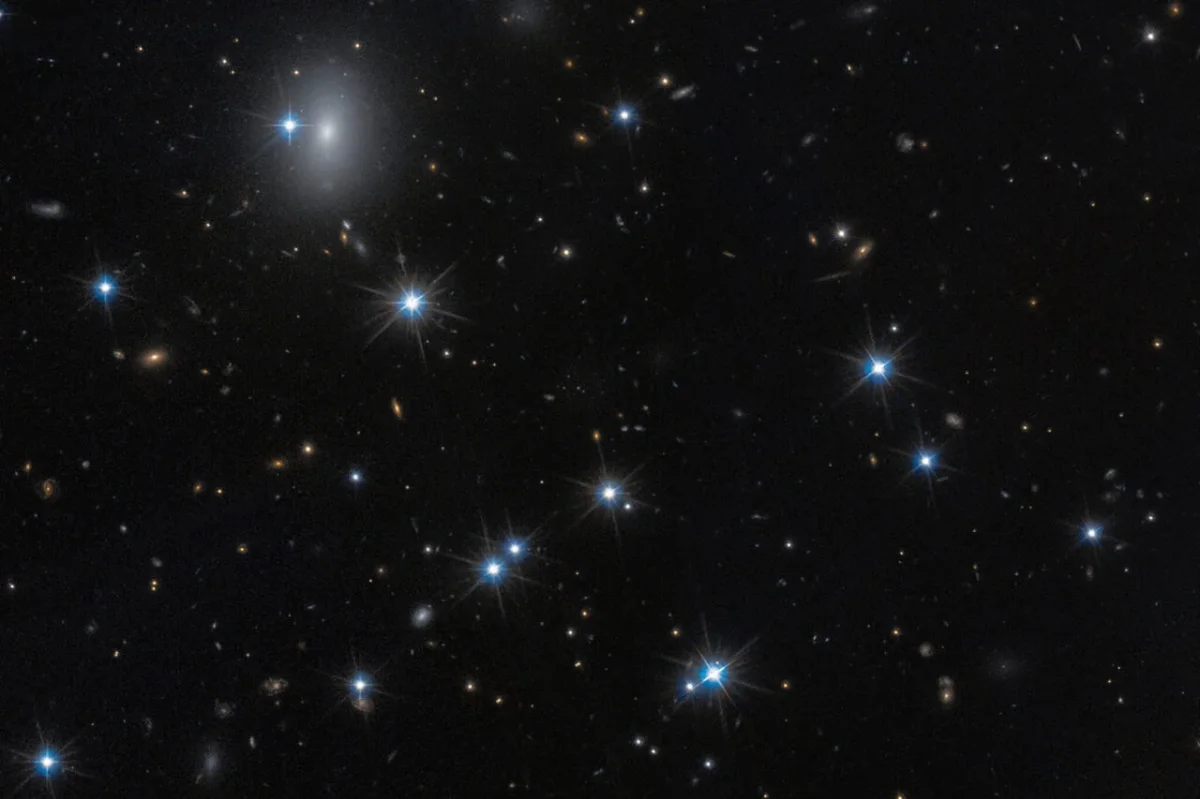

Astronomers have identified a potential dark galaxy, named CDG-2, located within the Perseus galaxy cluster. This discovery was made possible through high-resolution imaging shared by NASA and collaboration between the Hubble Space Telescope, ESA’s Euclid, and the Subaru Telescope in Hawaii. CDG-2 is notable for its exceptionally low surface brightness, suggesting it may contain a significant amount of dark matter.
Dark matter, which constitutes approximately 85% of the universe's mass, does not emit, absorb, or reflect light, making it elusive to direct detection. Despite this, scientists infer its presence by observing the gravitational effects it exerts on visible matter, including stars and galaxies. The existence of dark matter is crucial for current cosmological models, as its absence would lead to inconsistencies in our understanding of cosmic structures.
The findings, discussed in a paper published in The Astrophysical Journal Letters, indicate that dark galaxies like CDG-2 may possess extreme characteristics among known galaxies. The research team utilized statistical methods to analyze the data, revealing that the faint glow detected in the region could represent a previously unrecognized galaxy.