
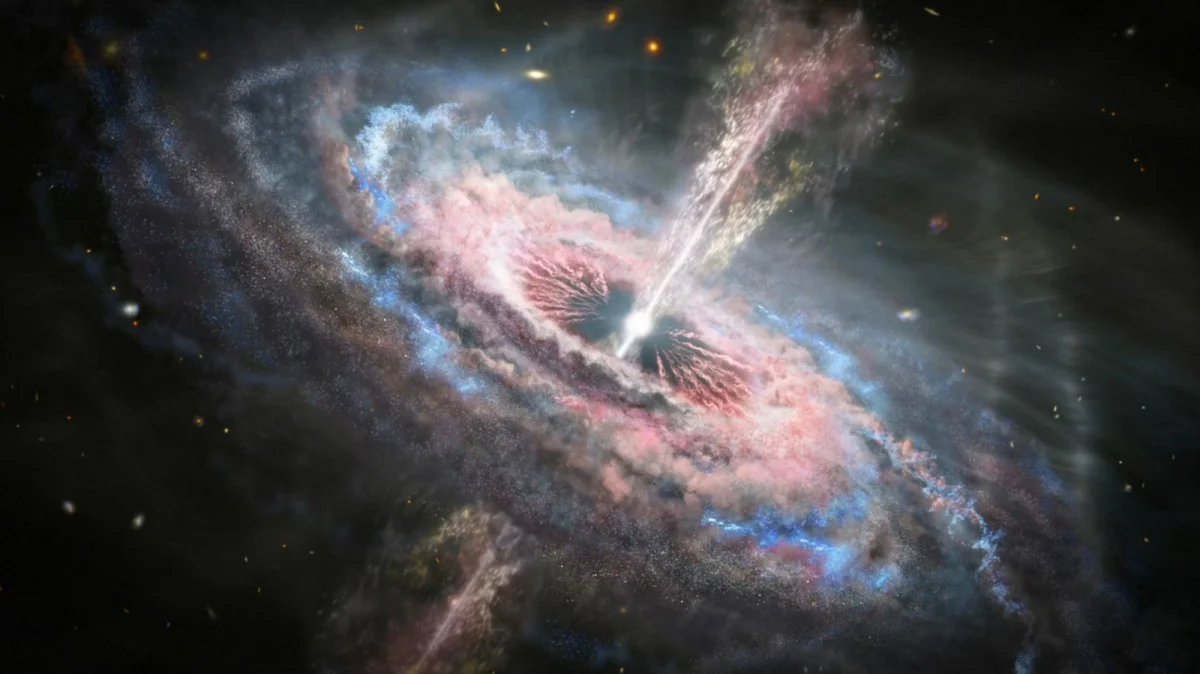

Astronomers uncover ancient supermassive black hole, reshaping galaxy formation theories

Astronomers uncover ancient supermassive black hole, reshaping galaxy formation theories

A supermassive black hole, 40 million times the sun's mass, may have formed just 700 million years post-Big Bang, challenging long-held astronomical theories.

NeboAI I summarize the news with data, figures and context
IN 30 SECONDS

IN 1 SENTENCE

SENTIMENT
Neutral

𒀭
NeboAI is working, please wait...
Preparing detailed analysis
Quick summary completed
Extracting data, figures and quotes...
Identifying key players and context
DETAILED ANALYSIS
SHARE

NeboAI produces automated editions of journalistic texts in the form of summaries and analyses. Its experimental results are based on artificial intelligence. As an AI edition, texts may occasionally contain errors, omissions, incorrect data relationships and other unforeseen inaccuracies. We recommend verifying the content.

The discovery of a supermassive black hole, designated as Abell2744-QSO1, is a groundbreaking finding from the James Webb Space Telescope, located 13 billion light-years away. This astronomical body, which is estimated to be 40 million times the mass of our sun, challenges existing theories about black hole formation, suggesting it formed within the first second after the Big Bang.

Researchers, including Professor Roberto Maiolino from Cambridge's Cavendish Laboratory, have reported that this black hole did not undergo the typical stellar collapse phase. Instead, it appears to have grown rapidly without consuming its surroundings, defying long-held beliefs that such growth requires a billion years. The findings mark the first direct mass measurement of a black hole from the early universe, achieved through detailed observations of this particular object.

For decades, it was thought that supermassive black holes formed slowly from existing galaxies. However, this recent evidence from #NASAWebb indicates a need to reassess classical theories regarding the evolution of black holes and their growth mechanisms. The Keplerian rotation of the gas surrounding QSO1 enabled scientists to calculate its mass accurately, revealing significant insights into the formation of these cosmic entities.

Want to read the full article? Access the original article with all the details.
Read Original Article
TL;DR

This article is an original summary for informational purposes. Image credits and full coverage at the original source. · View Content Policy

Editorial
Editorial Staff

Our editorial team works around the clock to bring you the latest tech news, trends, and insights from the industry. We cover everything from artificial intelligence breakthroughs to startup funding rounds, gadget launches, and cybersecurity threats. Our mission is to keep you informed with accurate, timely, and relevant technology coverage.

Press Enter to search or ESC to close