
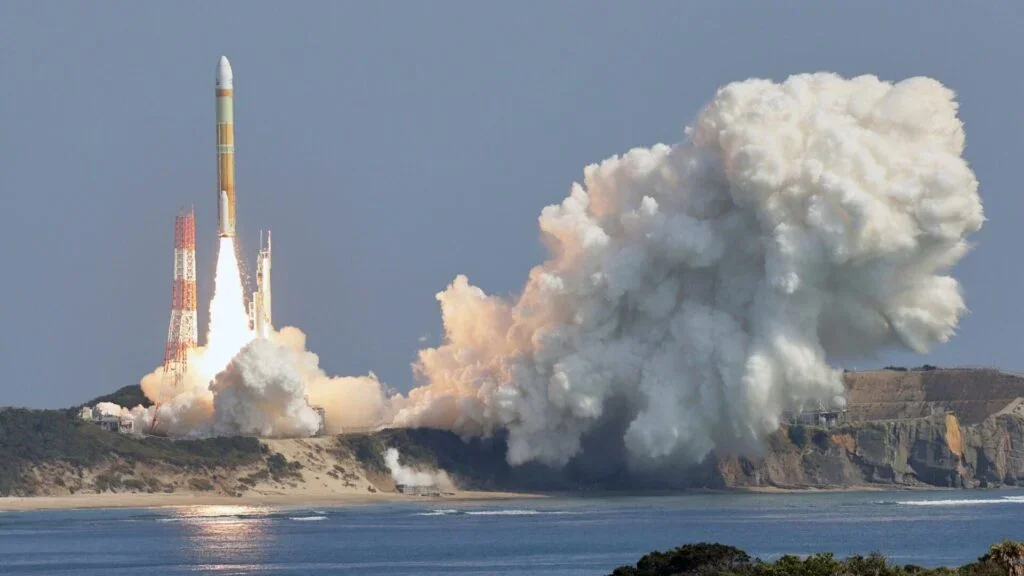

Japan's Unusual Satellite Launch Fail Highlights Risks in Space Exploration

Japan's Unusual Satellite Launch Fail Highlights Risks in Space Exploration

JAXA's H3 rocket lost the Michibiki 5 satellite due to a payload fairing failure just 4 minutes post-launch on December 21, leaving the satellite damaged and falling back to Earth.

NeboAI I summarize the news with data, figures and context
IN 30 SECONDS

IN 1 SENTENCE

SENTIMENT
Neutral

𒀭
NeboAI is working, please wait...
Preparing detailed analysis
Quick summary completed
Extracting data, figures and quotes...
Identifying key players and context
DETAILED ANALYSIS
SHARE

NeboAI produces automated editions of journalistic texts in the form of summaries and analyses. Its experimental results are based on artificial intelligence. As an AI edition, texts may occasionally contain errors, omissions, incorrect data relationships and other unforeseen inaccuracies. We recommend verifying the content.

The recent failure of Japan's H3 rocket has been attributed to an anomaly involving its payload, the Michibiki 5 navigation satellite, which was launched by the Japan Aerospace Exploration Agency (JAXA) on December 21, 2025. Shortly after liftoff, the rocket's second-stage engine experienced a fault, leading to its premature shutdown.

Approximately four minutes into the flight, the rocket's payload fairing, designed to protect the satellite, came apart. This separation left the satellite exposed and struggling to maintain its position, ultimately resulting in its descent back to Earth. JAXA's investigation revealed that pressure in the second-stage hydrogen tank began to drop during the first-stage burn, which delayed the first-stage engine cutoff by 27 seconds.

Footage from a camera on the payload adapter indicated that the satellite sustained damage during the fairing's separation, surrounded by debris as it lost its protective shell. This incident adds to the challenges faced by the H3 rocket system, which previously experienced a self-destruct command shortly after its initial launch on March 6, 2023, but has since successfully completed five missions.

Want to read the full article? Access the original article with all the details.
Read Original Article
TL;DR

This article is an original summary for informational purposes. Image credits and full coverage at the original source. · View Content Policy

Editorial
Editorial Staff

Our editorial team works around the clock to bring you the latest tech news, trends, and insights from the industry. We cover everything from artificial intelligence breakthroughs to startup funding rounds, gadget launches, and cybersecurity threats. Our mission is to keep you informed with accurate, timely, and relevant technology coverage.

Press Enter to search or ESC to close