
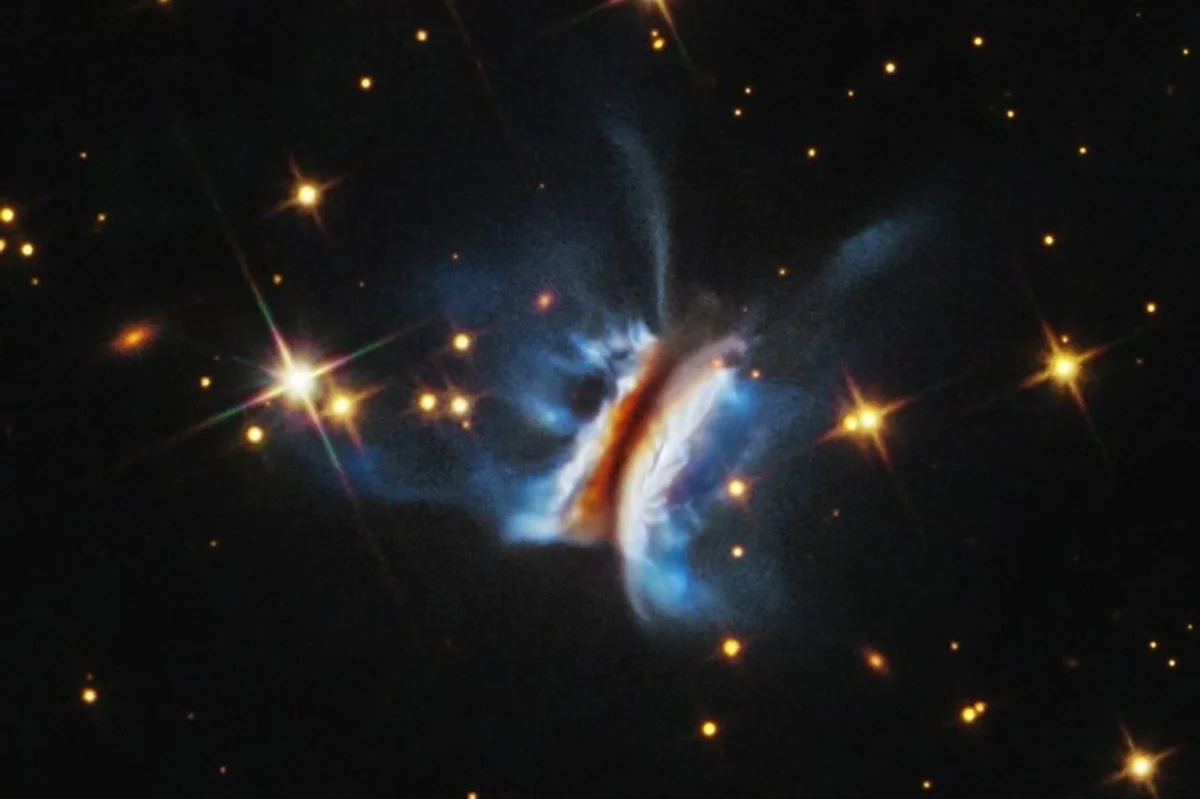

A newly captured image from NASA’s Hubble Space Telescope reveals a unique protoplanetary disk located approximately 1,000 light-years from Earth, the largest of its kind ever observed. Spanning nearly 400 billion miles (around 640 billion kilometers), this disk is about 40 times the width of our solar system, showcasing an unexpected chaotic environment that challenges previous assumptions about planet formation.
Identified in 2016, the disk has now been nicknamed “Dracula’s Chivito,” reflecting the cultural backgrounds of some researchers involved in the study. The findings, published on December 23 in The Astrophysical Journal, highlight the disk's asymmetric features, with material extending further on one side than the other, contradicting the belief that such disks are usually orderly.
Kristina Monsch, the lead author and postdoctoral researcher at the Center for Astrophysics, remarked on the unprecedented level of detail observed. Co-author Joshua Bennett Lovell noted the striking asymmetry of the disk, emphasizing the dynamic processes at play in shaping these celestial structures.