
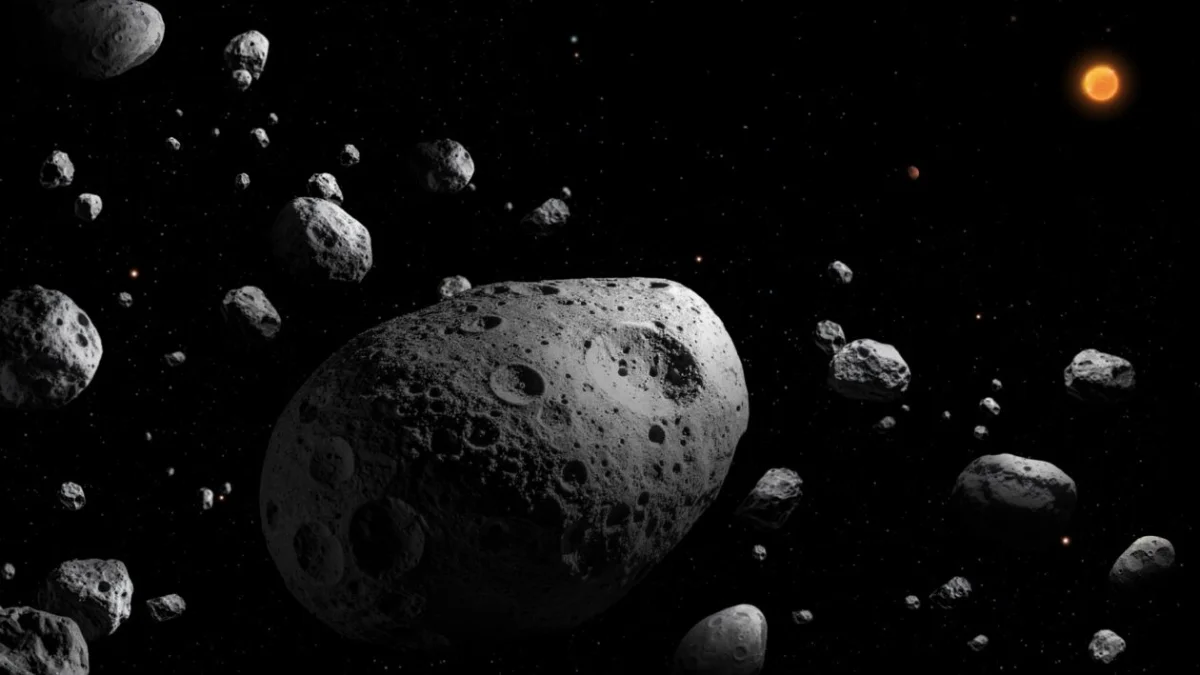

Asteroid Discovery by Rubin Observatory Challenges Existing Speed Records in Astronomy

Asteroid Discovery by Rubin Observatory Challenges Existing Speed Records in Astronomy

Astronomers identified 2025 MN45, a 710-meter asteroid rotating every 1.88 minutes, marking it as the fastest of its size. This discovery could reshape our understanding of asteroid compositions.

NeboAI I summarize the news with data, figures and context
IN 30 SECONDS

IN 1 SENTENCE

SENTIMENT
Neutral

𒀭
NeboAI is working, please wait...
Preparing detailed analysis
Quick summary completed
Extracting data, figures and quotes...
Identifying key players and context
DETAILED ANALYSIS
SHARE

NeboAI produces automated editions of journalistic texts in the form of summaries and analyses. Its experimental results are based on artificial intelligence. As an AI edition, texts may occasionally contain errors, omissions, incorrect data relationships and other unforeseen inaccuracies. We recommend verifying the content.

Astronomers have identified a rapidly rotating asteroid, designated as 2025 MN45, which completes a rotation in just 1.88 minutes. This finding was reported during the American Astronomical Society’s winter meeting in Phoenix by Sarah Greenstreet, an astronomer from the University of Washington. The asteroid has a diameter of nearly 710 meters and is now recognized as the fastest-spinning asteroid larger than 500 meters.

Data from the Vera C. Rubin Observatory was crucial in this discovery. Greenstreet, who leads the observatory’s working group for near-Earth objects, indicated that this research is the first peer-reviewed study utilizing information from the observatory’s LSST Camera in Chile. The team analyzed light variations from over 2,100 solar system objects, focusing on 76 asteroids to determine their characteristics.

Among the findings, 16 super-fast rotators were identified, with rotation periods ranging from 13 minutes to 2.2 hours. Additionally, three "ultra-fast rotators," including 2025 MN45, were noted for their exceptionally rapid rotation. Observations suggest that this asteroid is primarily composed of solid rock, differing from the more common "rubble pile" structures of many other asteroids.

Want to read the full article? Access the original article with all the details.
Read Original Article
TL;DR

This article is an original summary for informational purposes. Image credits and full coverage at the original source. · View Content Policy

Editorial
Editorial Staff

Our editorial team works around the clock to bring you the latest tech news, trends, and insights from the industry. We cover everything from artificial intelligence breakthroughs to startup funding rounds, gadget launches, and cybersecurity threats. Our mission is to keep you informed with accurate, timely, and relevant technology coverage.

Press Enter to search or ESC to close