
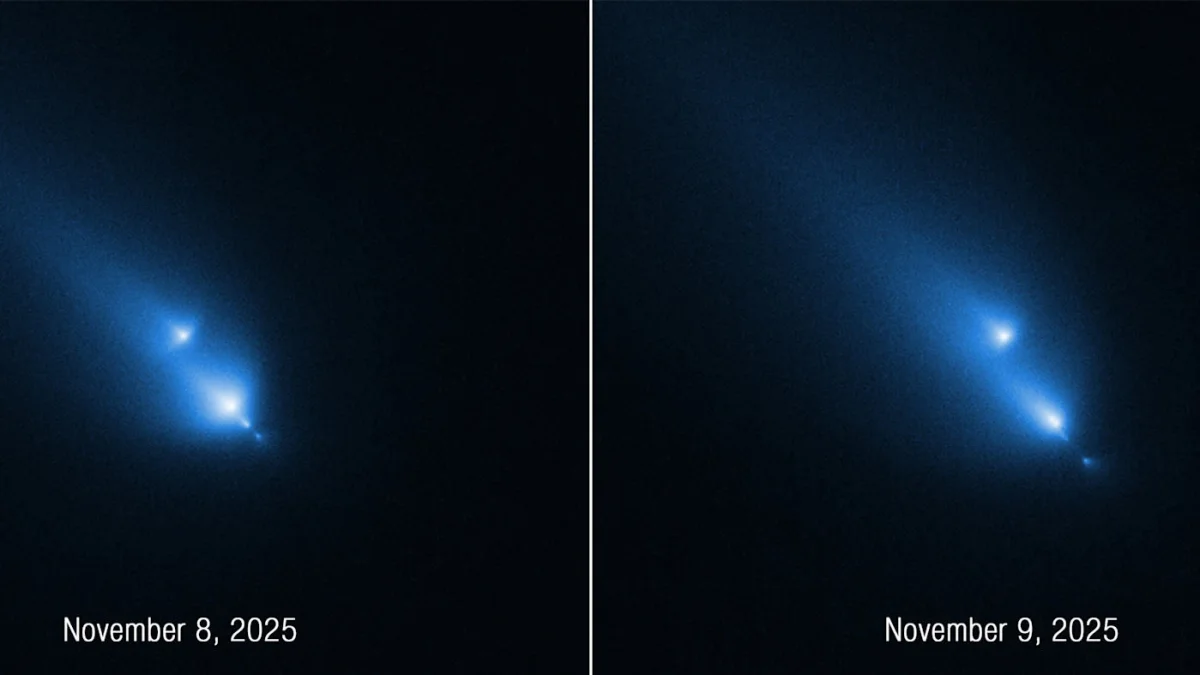

Images from the Hubble Space Telescope have revealed the remarkable disintegration of Comet C/2025 K1 as it exits the solar system. This unexpected event occurred while the comet was being observed for a different study, highlighting the serendipitous nature of scientific research.
The observation took place between November 8 and November 10, 2025, when the comet split into at least four fragments, each surrounded by a cloud of gas and dust. John Noonan, a research professor at Auburn University, noted that the original target for the study was not visible due to technical issues, leading to the accidental capture of K1 breaking apart.
Measuring approximately 8 kilometers (about 5 miles) in diameter, K1's larger-than-average size makes its disintegration particularly intriguing for researchers. The absence of carbon in the gases released during its breakup presents a unique chemical profile that could yield important insights into comet compositions.
Continuing studies of comets is crucial for understanding the early solar system, and the European Space Agency plans to enhance this knowledge with its upcoming Comet Interceptor mission, set to launch in 2028 or 2029. This mission aims to create a 3D model of a comet using images taken from various angles.