
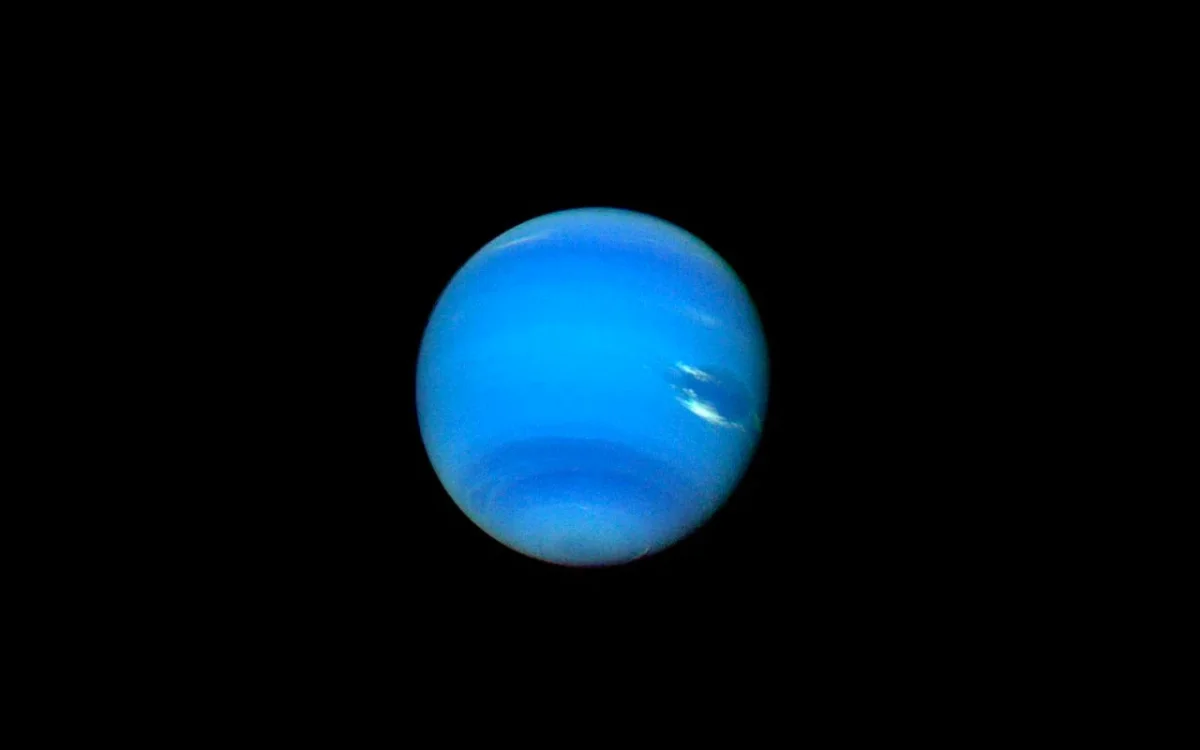

Recent findings suggest that Neptune's moon Nereid may be the sole remnant of a violent past involving the planet's largest moon, Triton. A study published in Science Advances reveals that Triton's entry into Neptune's orbit billions of years ago likely led to the destruction of Neptune's original moons. Researchers, led by Matthew Belyakov from the California Institute of Technology, used data from the Webb space telescope to analyze Nereid's surface characteristics.
Triton, discovered shortly after Neptune itself, is unique for its retrograde orbit and size, nearly matching that of Earth's Moon. This unusual behavior suggests it may be a captured object from the Kuiper Belt. In contrast, Nereid, taking 360 Earth days to orbit Neptune, exhibits the most eccentric orbit among moons in the solar system. The study implies that despite their coexistence, Triton and Nereid may not share a common origin.
The observations indicated that Nereid has a water-rich surface that distinguishes it from many Kuiper Belt objects. The researchers conducted simulations to explore the hypothesis of Nereid's integration into Neptune’s original moons, revealing that its history may diverge significantly from that of Triton.