
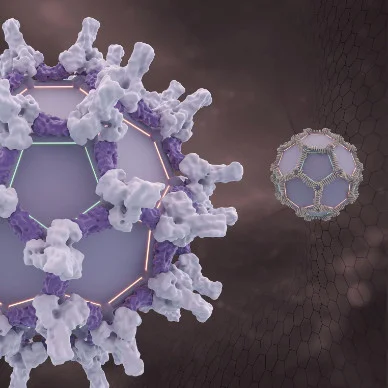

Researchers at the University of Washington’s Institute for Protein Design have developed innovative virus-like protein cages that could enhance gene therapy delivery methods. This advancement could potentially provide a more effective, less costly alternative to traditional gene delivery systems that rely on viruses, which can provoke adverse reactions and have limitations on genetic material quantity.
Details of this breakthrough were published in two papers in the journal Nature by a team led by Shunzhi Wang, a former postdoctoral scholar under Nobel laureate David Baker. The team, which included Sangmin Lee and David Chemielewski, explored methods to construct larger, quasisymmetrical protein cages, which are akin to a soccer ball made from pentagons and hexagons.
Initially, the assembly process faced challenges, often resulting in disorganized protein formations. However, through extensive experimentation and adjustments in geometric parameters, the researchers successfully created protein cages that are two to three times larger than previous designs, showcasing the potential for more spacious and effective delivery systems for therapeutic applications.