

Researchers identify potential sources of foul odors on distant alien planet

Researchers identify potential sources of foul odors on distant alien planet

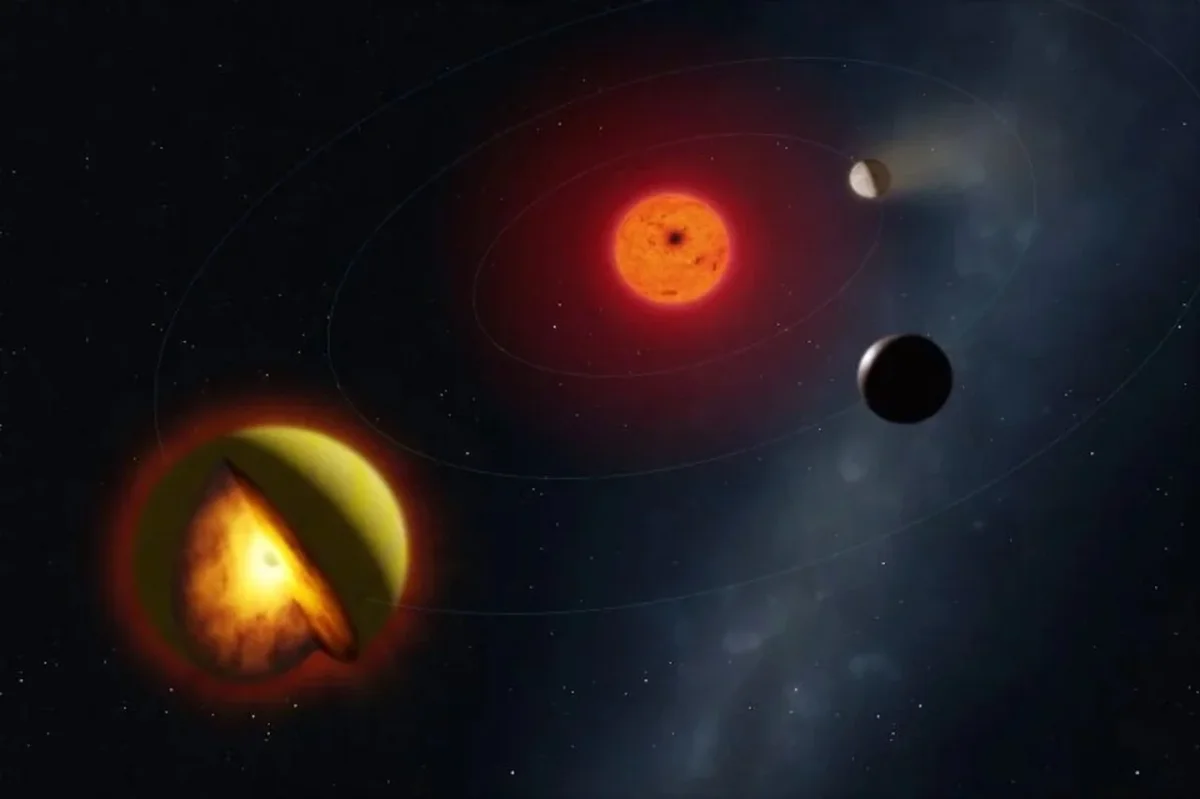
Astronomers have identified a new class of exoplanet, L 98-59 d, located 35 light-years away, featuring a magma ocean and sulfur-rich atmosphere, challenging existing planetary classifications.

NeboAI I summarize the news with data, figures and context
IN 30 SECONDS

IN 1 SENTENCE

SENTIMENT
Neutral

𒀭
NeboAI is working, please wait...
Preparing detailed analysis
Quick summary completed
Extracting data, figures and quotes...
Identifying key players and context
DETAILED ANALYSIS
SHARE

NeboAI produces automated editions of journalistic texts in the form of summaries and analyses. Its experimental results are based on artificial intelligence. As an AI edition, texts may occasionally contain errors, omissions, incorrect data relationships and other unforeseen inaccuracies. We recommend verifying the content.

Recent findings suggest the existence of a new class of exoplanets, challenging existing classifications. The planet, named L 98-59 d, was previously categorized as a super-Earth or sub-Neptune but has now been identified as a molten exoplanet with a significant magma ocean and volatile gases in its atmosphere.

This discovery was made using the Webb space telescope, with follow-up observations revealing high levels of sulfur dioxide among other gases. Located approximately 35 light-years from Earth, L 98-59 d is about twice the mass of our planet and orbits a cool, small star alongside four other planets.

Researchers from the University of Oxford, led by Harrison Nicholls, conducted computer simulations that traced the planet's evolution over five billion years. These simulations indicated that the planet's mantle is likely composed of molten silicate, similar to Earth's lava, and that the magma ocean facilitates chemical exchanges with its atmosphere.

The findings suggest that current classifications of small planets may be overly simplistic, prompting questions about other undiscovered planetary types in the universe.

Want to read the full article? Access the original article with all the details.
Read Original Article
TL;DR

This article is an original summary for informational purposes. Image credits and full coverage at the original source. · View Content Policy

Editorial
Editorial Staff

Our editorial team works around the clock to bring you the latest tech news, trends, and insights from the industry. We cover everything from artificial intelligence breakthroughs to startup funding rounds, gadget launches, and cybersecurity threats. Our mission is to keep you informed with accurate, timely, and relevant technology coverage.

Press Enter to search or ESC to close