

Blue Origin's New Glenn booster success overshadowed by payload launch failure

Blue Origin's New Glenn booster success overshadowed by payload launch failure

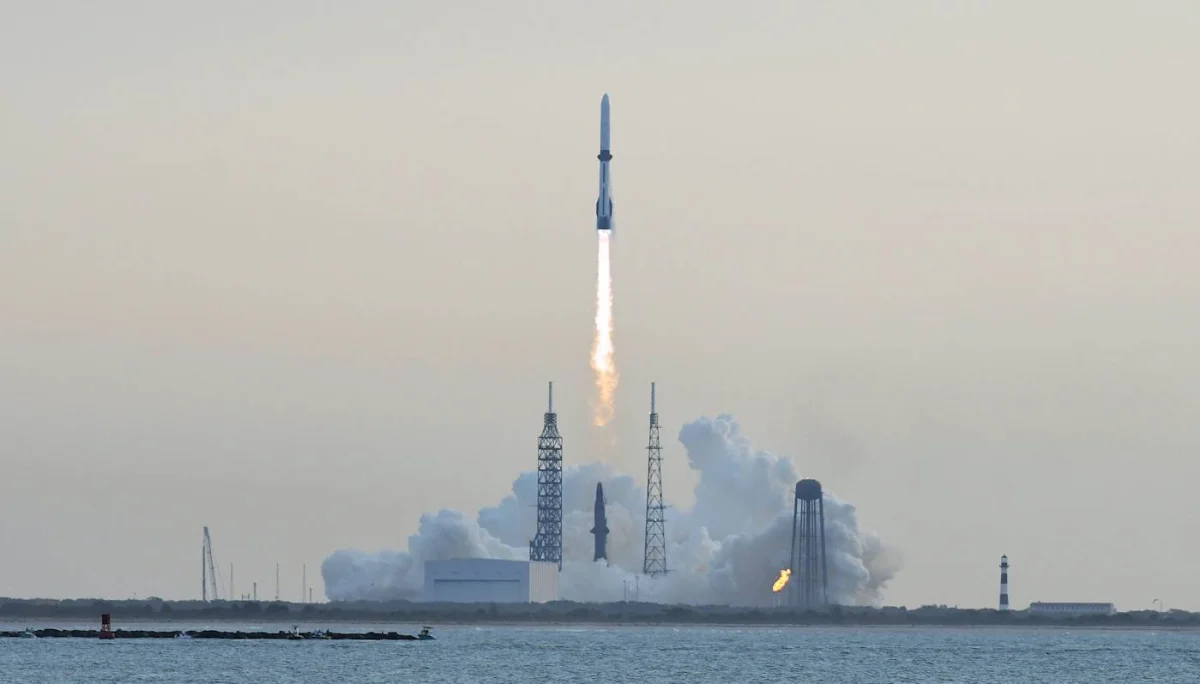
Blue Origin reused its New Glenn booster for the second time, but its payload failed to reach the required 285-mile orbit, only achieving 95 miles. Can they rectify this before the next Amazon Leo launch?

NeboAI I summarize the news with data, figures and context
IN 30 SECONDS

IN 1 SENTENCE

SENTIMENT
Neutral

𒀭
NeboAI is working, please wait...
Preparing detailed analysis
Quick summary completed
Extracting data, figures and quotes...
Identifying key players and context
DETAILED ANALYSIS
SHARE

NeboAI produces automated editions of journalistic texts in the form of summaries and analyses. Its experimental results are based on artificial intelligence. As an AI edition, texts may occasionally contain errors, omissions, incorrect data relationships and other unforeseen inaccuracies. We recommend verifying the content.

Blue Origin achieved a significant milestone by successfully reusing its first-stage New Glenn booster, known as Never Tell me the Odds, for the second time on its third mission, NG-3. The booster completed a controlled landing on a recovery ship after separating smoothly from the rocket three minutes post-launch. However, the mission was overshadowed by a failure to place the intended communications satellite into a sustainable orbit.

Hours after the launch, both Blue Origin and satellite manufacturer AST SpaceMobile confirmed that the payload had failed to reach the necessary altitude. Initial reports indicated that while the satellite powered on after separation, it entered an off-nominal orbit at only 95 miles, significantly below the targeted 285-mile orbit. AST SpaceMobile later noted that the satellite would de-orbit due to insufficient altitude for operational capabilities.

Despite these setbacks, Blue Origin's successful first-stage reuse is noteworthy, especially when compared to SpaceX, which took 32 missions before achieving a similar feat. The next mission for Blue Origin will focus on launching Amazon Leo broadband satellites, with plans to deploy 48 units in its upcoming flight.

Want to read the full article? Access the original article with all the details.
Read Original Article
TL;DR

This article is an original summary for informational purposes. Image credits and full coverage at the original source. · View Content Policy

Editorial
Editorial Staff

Our editorial team works around the clock to bring you the latest tech news, trends, and insights from the industry. We cover everything from artificial intelligence breakthroughs to startup funding rounds, gadget launches, and cybersecurity threats. Our mission is to keep you informed with accurate, timely, and relevant technology coverage.

Press Enter to search or ESC to close