
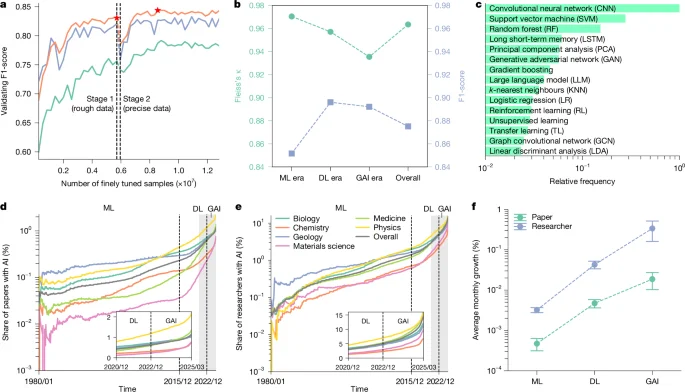

Recent advancements in artificial intelligence are significantly impacting scientific research across various disciplines. A study published in Nature by Wang et al. highlights the increasing reliance on AI tools to enhance research capabilities and accelerate outcomes. The integration of machine learning and data analysis is transforming traditional methods, with AI proving essential in areas such as healthcare, education, and fundamental scientific inquiries.
Notably, the introduction of AlphaFold has dramatically improved protein structure prediction, showcasing high accuracy in modeling complex biological molecules. This development follows foundational work by AI pioneers such as Geoffrey Hinton and Yann LeCun, whose contributions to neural networks and deep learning continue to shape modern algorithms. In the educational sphere, tools like ChatGPT are being investigated for their potential to enhance scholarly communication, with studies assessing the effectiveness of AI-generated abstracts.
Furthermore, the ethical implications of AI in both education and healthcare are under scrutiny. Research by Akgun and Greenhow emphasizes the need for ethical considerations in AI deployment within K-12 settings, while Meskó and Topol's 2023 analysis calls for regulatory frameworks to guide the use of generative AI in medical applications.