
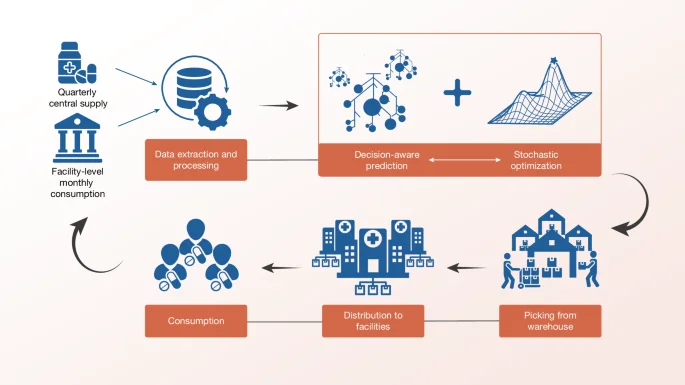

Decision-Aware Machine Learning Revolutionizes Access to Essential Medicines by 30%

Decision-Aware Machine Learning Revolutionizes Access to Essential Medicines by 30%

In Zambia, innovative inventory policies aim to tackle critical medicine access issues, with research indicating a framework could revolutionize supply chains across Africa.

NeboAI I summarize the news with data, figures and context
IN 30 SECONDS

IN 1 SENTENCE

SENTIMENT
Neutral

𒀭
NeboAI is working, please wait...
Preparing detailed analysis
Quick summary completed
Extracting data, figures and quotes...
Identifying key players and context
DETAILED ANALYSIS
SHARE

NeboAI produces automated editions of journalistic texts in the form of summaries and analyses. Its experimental results are based on artificial intelligence. As an AI edition, texts may occasionally contain errors, omissions, incorrect data relationships and other unforeseen inaccuracies. We recommend verifying the content.

Recent studies indicate that the availability of essential medicines in developing nations is critically low, significantly impacting efforts to achieve Sustainable Development Goal 3, which focuses on health and well-being. The operational challenges faced by health product supply chains in regions like Zambia and other African countries have been thoroughly examined in various research publications.

A notable contribution to this field comes from Gallien, Leung, and Yadav, who propose innovative inventory management strategies aimed at enhancing pharmaceutical distribution in Zambia. Their framework not only addresses current disparities in access but also highlights the importance of local demand forecasting.

Furthermore, UNICEF's “State of the World’s Children 2015” report underscores the dire situation affecting women and children, emphasizing the urgent need for reform in health systems. The intersection of technology and healthcare is gaining traction, with several studies exploring machine learning as a means to improve healthcare delivery. Esteva et al. and Ngiam and Khor focus on how these advanced technologies could transform patient care and optimize operations in healthcare settings.

The COVID-19 pandemic has amplified the necessity for strong healthcare infrastructure, with research by Bastani et al. illustrating how reinforcement learning can enhance public health responses during crises. This evolving landscape calls for immediate, actionable strategies to strengthen supply chains and healthcare systems across the continent.

Want to read the full article? Access the original article with all the details.
Read Original Article
TL;DR

This article is an original summary for informational purposes. Image credits and full coverage at the original source. · View Content Policy

Editorial
Editorial Staff

Our editorial team works around the clock to bring you the latest tech news, trends, and insights from the industry. We cover everything from artificial intelligence breakthroughs to startup funding rounds, gadget launches, and cybersecurity threats. Our mission is to keep you informed with accurate, timely, and relevant technology coverage.

Press Enter to search or ESC to close