
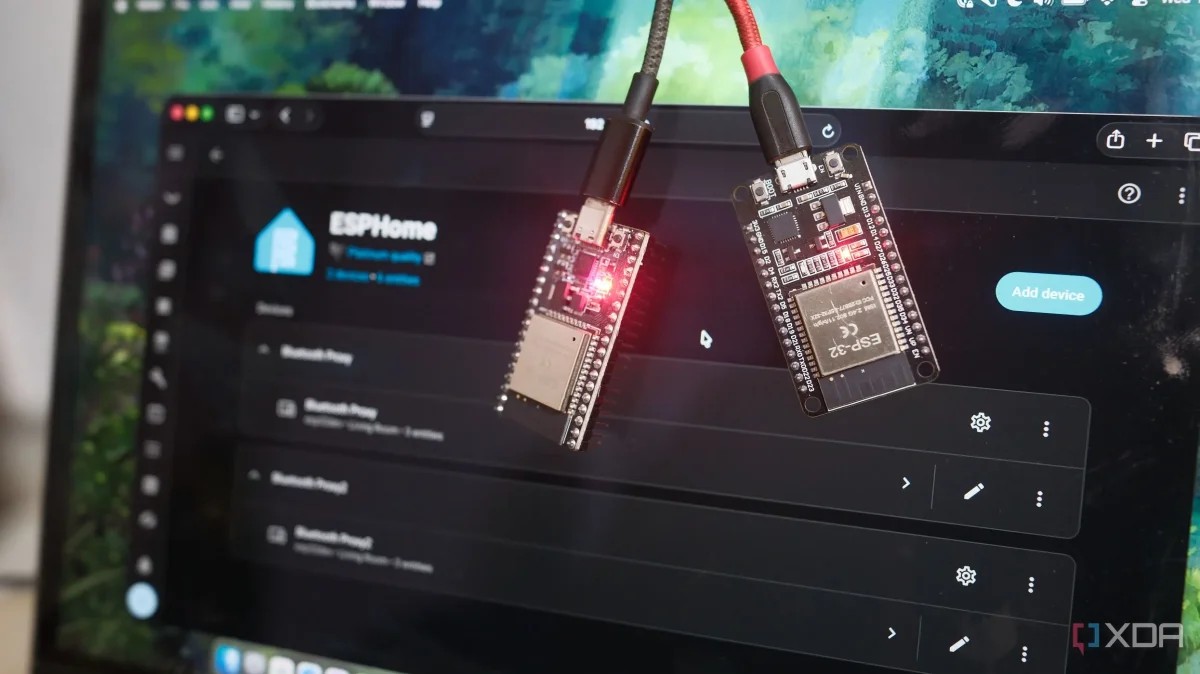

Transform Your Home: Discover 6 Innovative ESPHome Projects for Smart Living

Transform Your Home: Discover 6 Innovative ESPHome Projects for Smart Living

ESP32 and ESP8266 microcontrollers, starting at just $2, enable custom smart home projects with local control. Discover budget-friendly solutions that elevate your home automation experience.

NeboAI I summarize the news with data, figures and context
IN 30 SECONDS

IN 1 SENTENCE

SENTIMENT
Neutral

𒀭
NeboAI is working, please wait...
Preparing detailed analysis
Quick summary completed
Extracting data, figures and quotes...
Identifying key players and context
DETAILED ANALYSIS
SHARE

NeboAI produces automated editions of journalistic texts in the form of summaries and analyses. Its experimental results are based on artificial intelligence. As an AI edition, texts may occasionally contain errors, omissions, incorrect data relationships and other unforeseen inaccuracies. We recommend verifying the content.

ESPHome offers a versatile platform for creating customized smart home devices, allowing users to maintain local control over their technology. The framework supports devices that adhere to open standards, making it accessible for hobbyists and tinkerers alike.

To embark on your projects, basic components such as the ESP32 microcontroller, costing around $5, or the ESP8266, priced at approximately $2, are essential. For those looking to experiment, a 37-in-1 sensor kit provides a budget-friendly option, although higher-quality sensors can be purchased separately to enhance functionality.

Among the intriguing projects available is a garage door sensor that utilizes a multi-axis accelerometer and gyroscope sensor (MPU6050) in conjunction with the ESP32 board. This setup can monitor not just whether the door is open or closed, but also if it’s partially stuck. Another project focuses on kid's rooms, where an analog sound sensor (MAX9814) enables continuous noise level monitoring, allowing parents to receive notifications based on sound thresholds.

Additionally, a presence sensor can be integrated into desk lighting systems, using a human presence detection sensor (LD2410C) with an ESP32-S3 or ESP32-C6 board to enhance workspace productivity by adjusting lighting based on occupancy.

Want to read the full article? Access the original article with all the details.
Read Original Article
TL;DR

This article is an original summary for informational purposes. Image credits and full coverage at the original source. · View Content Policy

Editorial
Editorial Staff

Our editorial team works around the clock to bring you the latest tech news, trends, and insights from the industry. We cover everything from artificial intelligence breakthroughs to startup funding rounds, gadget launches, and cybersecurity threats. Our mission is to keep you informed with accurate, timely, and relevant technology coverage.

Press Enter to search or ESC to close