
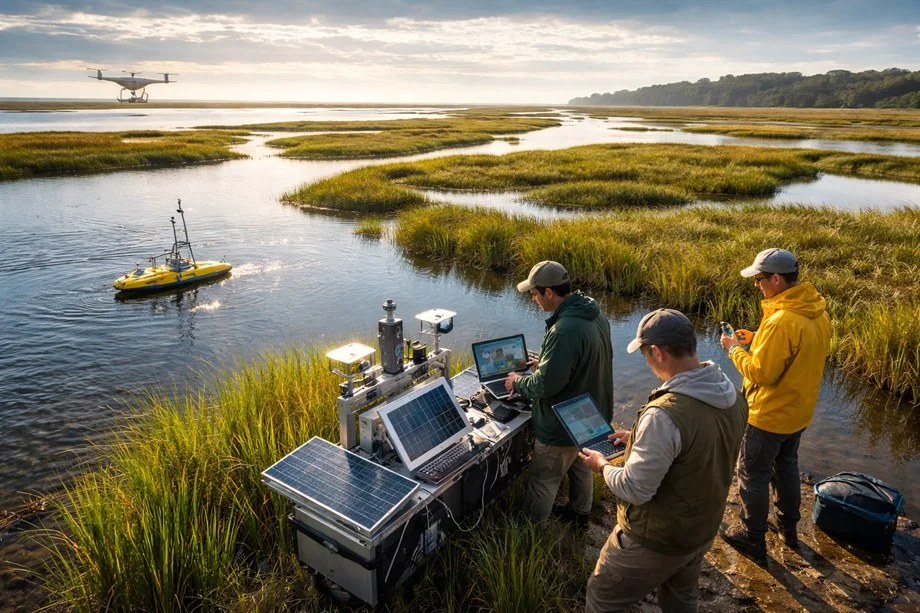

Study Reveals AI's Role in Shaping Future of 96 Transitional Water Ecosystems

Study Reveals AI's Role in Shaping Future of 96 Transitional Water Ecosystems

AI tools are revolutionizing ecosystem monitoring, with over 44% of studies focusing on regression models for vital environmental assessments, paving the way for advanced ecological management.

NeboAI I summarize the news with data, figures and context
IN 30 SECONDS

IN 1 SENTENCE

SENTIMENT
Neutral

𒀭
NeboAI is working, please wait...
Preparing detailed analysis
Quick summary completed
Extracting data, figures and quotes...
Identifying key players and context
DETAILED ANALYSIS
SHARE

NeboAI produces automated editions of journalistic texts in the form of summaries and analyses. Its experimental results are based on artificial intelligence. As an AI edition, texts may occasionally contain errors, omissions, incorrect data relationships and other unforeseen inaccuracies. We recommend verifying the content.

A systematic review published in the journal Environments assesses the application of artificial intelligence in monitoring transitional water ecosystems, revealing significant insights from 96 peer-reviewed studies. This comprehensive analysis highlights the growing importance of machine learning tools for understanding complex environments such as estuaries and coastal wetlands, where traditional ecological models often fall short.

AI's capability to manage large sets of diverse data enables it to identify patterns in these nonlinear ecosystems effectively. Dominant techniques, including Random Forest and Support Vector Machines, excel in tasks like predicting water quality and locating pollution sources. Notably, regression-based methods make up over 44 percent of the reviewed methodologies, focusing on estimating environmental variables such as nutrient and chlorophyll levels.

Moreover, water quality monitoring has emerged as a crucial application of AI, facilitating rapid response to pollution incidents. Beyond this area, the technology also plays a role in biodiversity assessment and habitat mapping, often utilizing data from remote sensing and in situ sensors. The rise of deep learning technologies since 2020 is noted as a transformative development in the field, enhancing the capacity for ecosystem forecasting and comprehensive analysis.

Want to read the full article? Access the original article with all the details.
Read Original Article
TL;DR

This article is an original summary for informational purposes. Image credits and full coverage at the original source. · View Content Policy

Editorial
Editorial Staff

Our editorial team works around the clock to bring you the latest tech news, trends, and insights from the industry. We cover everything from artificial intelligence breakthroughs to startup funding rounds, gadget launches, and cybersecurity threats. Our mission is to keep you informed with accurate, timely, and relevant technology coverage.

Press Enter to search or ESC to close