
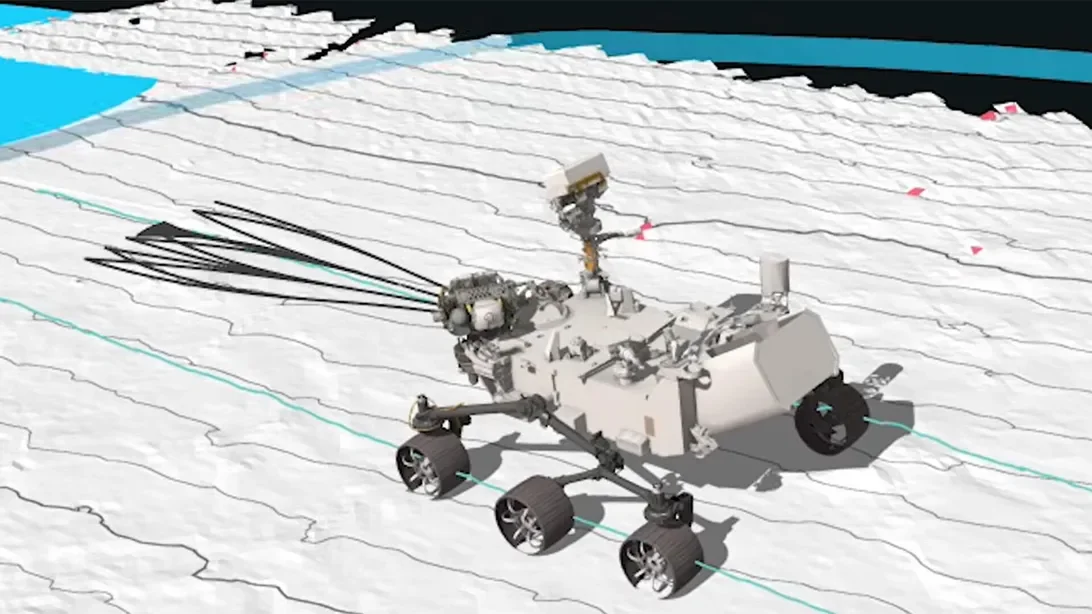

NASA's AI-Powered Mars Rover Successfully Maneuvers Autonomously, Setting New Milestones

NASA's AI-Powered Mars Rover Successfully Maneuvers Autonomously, Setting New Milestones

NASA's Perseverance rover successfully navigated nearly 1,500 feet on Mars using AI for course plotting, marking a milestone in autonomous space exploration. Discover how this technology reshapes future missions.

NeboAI I summarize the news with data, figures and context
IN 30 SECONDS

IN 1 SENTENCE

SENTIMENT
Neutral

𒀭
NeboAI is working, please wait...
Preparing detailed analysis
Quick summary completed
Extracting data, figures and quotes...
Identifying key players and context
DETAILED ANALYSIS
SHARE

NeboAI produces automated editions of journalistic texts in the form of summaries and analyses. Its experimental results are based on artificial intelligence. As an AI edition, texts may occasionally contain errors, omissions, incorrect data relationships and other unforeseen inaccuracies. We recommend verifying the content.

NASA's Perseverance rover successfully traveled just under 1,500 feet in two autonomous drives, the first time using artificial intelligence for route planning. The demonstration, conducted on December 8 and December 10, involved AI models from Anthropic's Claude, which plotted the rover's course while NASA's Jet Propulsion Lab (JPL) verified the path for safety.

The AI utilized satellite imagery and data from NASA's Mars Reconnaissance Orbiter, mirroring the information typically used by human operators. Claude's initial route was slightly adjusted by JPL before being sent to Perseverance for autonomous navigation. NASA Administrator Jared Isaacman noted that this advancement highlights the potential for AI technologies to enhance mission efficiency and adaptability on distant worlds.

Typically, Perseverance's waypoints are spaced no more than 330 feet apart, allowing for careful exploration of the Martian terrain. In a notable ascent from the Jezero Crater earlier this year, the rover climbed 1,640 vertical feet over a period of 3.5 months. The successful AI demonstrations indicate a significant step forward in Mars exploration methodologies.

Want to read the full article? Access the original article with all the details.
Read Original Article
TL;DR

This article is an original summary for informational purposes. Image credits and full coverage at the original source. · View Content Policy

Editorial
Editorial Staff

Our editorial team works around the clock to bring you the latest tech news, trends, and insights from the industry. We cover everything from artificial intelligence breakthroughs to startup funding rounds, gadget launches, and cybersecurity threats. Our mission is to keep you informed with accurate, timely, and relevant technology coverage.

Press Enter to search or ESC to close