

Experts Warn: Deepfake Technology at UMich Could Erode Public Trust and Ethics

Experts Warn: Deepfake Technology at UMich Could Erode Public Trust and Ethics

Over 40 participants gathered at the University of Michigan's AI event to explore the risks of deepfakes, emphasizing the urgent need for ethical AI education in an evolving job market.

NeboAI I summarize the news with data, figures and context
IN 30 SECONDS

IN 1 SENTENCE

SENTIMENT
Neutral

𒀭
NeboAI is working, please wait...
Preparing detailed analysis
Quick summary completed
Extracting data, figures and quotes...
Identifying key players and context
DETAILED ANALYSIS
SHARE

NeboAI produces automated editions of journalistic texts in the form of summaries and analyses. Its experimental results are based on artificial intelligence. As an AI edition, texts may occasionally contain errors, omissions, incorrect data relationships and other unforeseen inaccuracies. We recommend verifying the content.

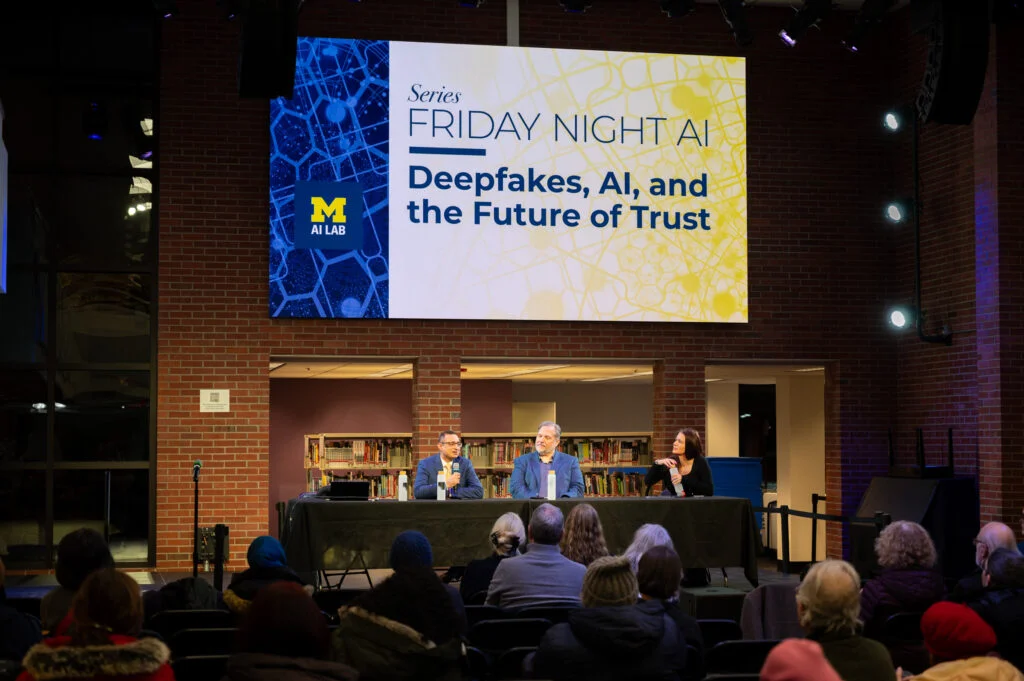
On January 23, an event named “Friday Night AI: Deepfakes, AI, and the Future of Trust” was held at the Ann Arbor District Library, drawing over 40 participants, including students and community members. This initiative is part of the eighth annual AI Symposium series, organized by the University of Michigan Artificial Intelligence Laboratory in collaboration with U-M Flint’s College of Innovation and Technology and the School of Information.

The session aimed to inform the public about the implications of artificial intelligence, particularly the challenges posed by deepfakes—realistic images or videos created by machine learning. Yara El-Tawil, a Rackham student, led an interactive session where attendees analyzed pairs of photos and videos to identify authentic content versus deepfakes. She highlighted the complex societal ramifications of this technology and the ongoing efforts by researchers to ethically navigate AI development.

Cliff Lampe, an associate dean at the School of Information, stressed the necessity of AI education for students as they face a changing job landscape. He remarked that while some traditional jobs may vanish, new opportunities will emerge. Khalid Malik, a professor and director at U-M Flint’s College of Innovation and Technology, noted the increasing realism of deepfakes and emphasized the need for ongoing research to maintain human oversight in technology development.

Want to read the full article? Access the original article with all the details.
Read Original Article
TL;DR

This article is an original summary for informational purposes. Image credits and full coverage at the original source. · View Content Policy

Editorial
Editorial Staff

Our editorial team works around the clock to bring you the latest tech news, trends, and insights from the industry. We cover everything from artificial intelligence breakthroughs to startup funding rounds, gadget launches, and cybersecurity threats. Our mission is to keep you informed with accurate, timely, and relevant technology coverage.

Press Enter to search or ESC to close