

Dhireesha Kudithipudi's THOR Commons Set to Transform AI Accessibility for Innovators

Dhireesha Kudithipudi's THOR Commons Set to Transform AI Accessibility for Innovators

Dhireesha Kudithipudi leads a groundbreaking project in neuromorphic computing at UTSA, aiming to democratize access and enhance AI efficiency for medical applications nationwide.

NeboAI I summarize the news with data, figures and context
IN 30 SECONDS

IN 1 SENTENCE

SENTIMENT
Neutral

𒀭
NeboAI is working, please wait...
Preparing detailed analysis
Quick summary completed
Extracting data, figures and quotes...
Identifying key players and context
DETAILED ANALYSIS
SHARE

NeboAI produces automated editions of journalistic texts in the form of summaries and analyses. Its experimental results are based on artificial intelligence. As an AI edition, texts may occasionally contain errors, omissions, incorrect data relationships and other unforeseen inaccuracies. We recommend verifying the content.

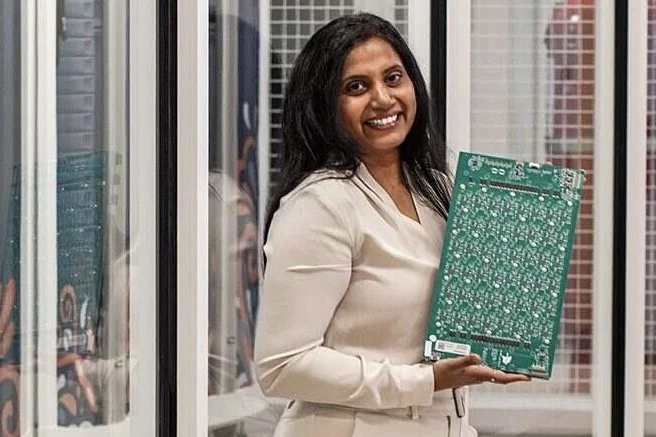
With the launch of THOR: The Neuromorphic Commons, a groundbreaking hub for neuromorphic computing, Dhireesha Kudithipudi is transforming the technological landscape in the United States. This initiative, based at the University of Texas at San Antonio (UTSA) and funded by the National Science Foundation, aims to make neuromorphic computing accessible to researchers and students across the country.

Unlike traditional silicon chips that require high energy for processing, neuromorphic systems operate on an “event-based” model, activating only in response to new data. This innovation is facilitated by the SpiNNaker2 system, which features around 400,000 processing elements and utilizes energy-efficient ARM-based cores similar to those in smartphones. By providing open access, UTSA is lowering barriers for future engineers and expanding collaborations between academia and industry.

Kudithipudi, who serves as the Robert F. McDermott Chair in Engineering, emphasizes that THOR serves as a national hub for neuromorphic computing. This technology has potential applications in medical devices, such as pacemakers that can adapt to a patient’s needs and hearing aids that optimize sound without excessive battery drain. Additionally, the project seeks to tackle the challenge of “catastrophic forgetting” in AI systems by mimicking the brain's lifelong learning abilities.

Want to read the full article? Access the original article with all the details.
Read Original Article
TL;DR

This article is an original summary for informational purposes. Image credits and full coverage at the original source. · View Content Policy

Editorial
Editorial Staff

Our editorial team works around the clock to bring you the latest tech news, trends, and insights from the industry. We cover everything from artificial intelligence breakthroughs to startup funding rounds, gadget launches, and cybersecurity threats. Our mission is to keep you informed with accurate, timely, and relevant technology coverage.

Press Enter to search or ESC to close