

AI Breakthrough by Penn Engineers Cuts Memory Usage by 90% for Complex Math Solutions

AI Breakthrough by Penn Engineers Cuts Memory Usage by 90% for Complex Math Solutions

Engineers at the University of Pennsylvania tackle complex inverse PDEs with a new AI method, reducing memory use from 2.70 GB to 0.21 GB, enhancing stability in data analysis.

NeboAI I summarize the news with data, figures and context
IN 30 SECONDS

IN 1 SENTENCE

SENTIMENT
Neutral

𒀭
NeboAI is working, please wait...
Preparing detailed analysis
Quick summary completed
Extracting data, figures and quotes...
Identifying key players and context
DETAILED ANALYSIS
SHARE

NeboAI produces automated editions of journalistic texts in the form of summaries and analyses. Its experimental results are based on artificial intelligence. As an AI edition, texts may occasionally contain errors, omissions, incorrect data relationships and other unforeseen inaccuracies. We recommend verifying the content.

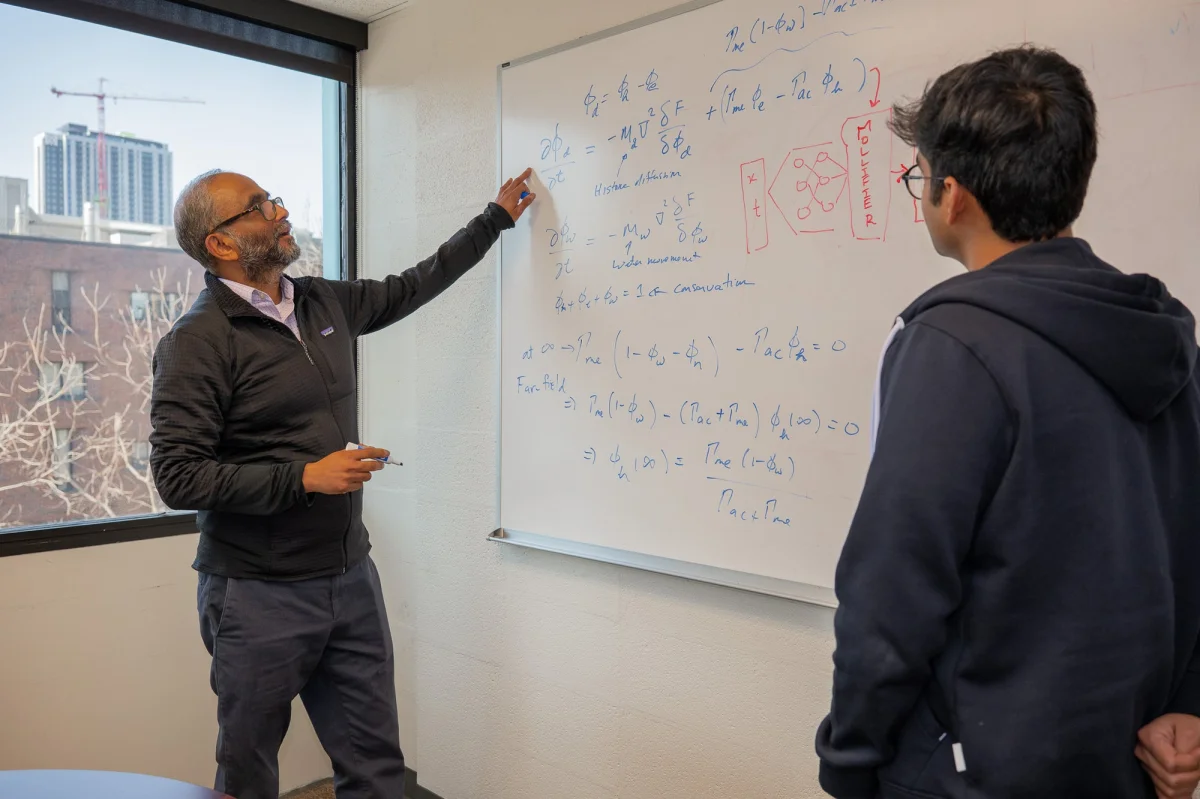
Engineers at the University of Pennsylvania have introduced a groundbreaking method known as “Mollifier Layers” to address the complexities of inverse partial differential equations (inverse PDEs). These equations are essential across various scientific domains including weather systems, biology, and materials science, yet they present significant challenges as they require deducing underlying causes from observable phenomena.

The researchers plan to showcase their findings at NeurIPS 2026, marking a shift from conventional AI methods that emphasize model size and computational strength. Senior author Vivek Shenoy, who holds the title of Eduardo D. Glandt President’s Distinguished Professor in Materials Science and Engineering, likens the challenge of inverse PDEs to the difficulty of identifying the source of ripples in a pond.

Traditional approaches in AI have struggled with the differentiation process, which is crucial for measuring changes in these complex systems. The Penn team noted a notable increase in memory usage—from 0.21 gigabytes to 2.70 gigabytes—when analyzing a fourth-order reaction-diffusion problem. By integrating mollifiers, a mathematical tool that smooths functions, they aim to enhance the stability of derivative calculations and improve the efficiency of their model.

Want to read the full article? Access the original article with all the details.
Read Original Article
TL;DR

This article is an original summary for informational purposes. Image credits and full coverage at the original source. · View Content Policy

Editorial
Editorial Staff

Our editorial team works around the clock to bring you the latest tech news, trends, and insights from the industry. We cover everything from artificial intelligence breakthroughs to startup funding rounds, gadget launches, and cybersecurity threats. Our mission is to keep you informed with accurate, timely, and relevant technology coverage.

Press Enter to search or ESC to close